
Zaina's journey to a PhD
Zaina may be a long way from home, over 9,500 km away, but she’s right where she wants to be. She’s excited to finally start her PhD at QCGC Research after a long journey both geographically and figuratively.
Zaina is originally from Mauritius, an island nation off the African coast, famous for its biodiverse flora and fauna, white beaches, and as the only home of the extinct Dodo bird. Growing up, Zaina knew she wanted to study overseas, even though it meant leaving her family.
Early ambitions and moving abroad
At 18, she began a Diploma in Biotechnology at RMIT in Melbourne, to test whether the field was right for her. While studying, she worked as a lab technician for Bioproperties and discovered a love for biotech and lab research. She went on to complete a Bachelor of Biomedical Science at the Australian Catholic University (ACU), earning a merit-based scholarship. She later recevied a second competitive scholarship, awarded on academic merit, to undertake her Honours research.
Known for her diligence, drive, and track record, Zaina was offered marking work, which soon led to teaching opportunities.
Discovering a passion for science and teaching
“I always thought of myself as someone who preferred working independently, but teaching turned out to be one of the most rewarding parts of my career.” Zaina says. “Receiving consistently positive feedback from students gave me the confidence to move into academic leadership, complete a postgraduate qualification in higher education, and develop curriculum and new ways to engage every learner.”
While Zaina took an eight-year break from formal study, she spent that time building her academic career and saving towards her goal of completing a PhD. Through teaching practical laboratory classes, she also remained closely connected to hands-on science.
After 11 years in Australia, Zaina became an Australian citizen and returned to university to pursue her Honours in immunology.
Returning to research
“For years, I had been working towards this moment” Zaina says. “I began my Honours in immunology while maintaining a full sessional teaching workload. I studied immunity to COVID-19 following the pandemic, and within just two months I recruited 100 participants. I analysed their immune and biological factors to better understand why immunity varies between people after vaccination and COVID-19 infection.”
Zaina graduated with First Class Honours, achieving the highest academic performance at ACU nationally, and was awarded the University Medal in recognition of this achievement. The day she submitted her Honours thesis, she was already searching for her next challenge: a PhD.
A meaningful project: personalising cancer care
“I was looking for a meaningful project that involved bench-to-bedside,” Zaina said. “When Eva pitched the idea of investigating the blood samples collected during the ENDO-3 and feMMe trials to identify biological markers that could be used to personalise gynaecological cancer care, I could feel how passionate she was about the project.”
Zaina has three supervisors: Dr Eva Baxter, Professor Andreas Obermair, and Professor Carlos Salomon.
To conduct her PhD, Zaina will also have to train in the innovative technique developed by Carlos to isolate and analyse extracellular vesicles: tiny membrane-bound particles released by cells that carry important biological information.
“We hope to identify signals in the blood that can help accurately diagnose endometrial cancer, show how well treatment is working, and predict who will develop a recurrence,” Zaina says.
Teamwork and support
Zaina has already had the chance to get to know the QCGC team, as she’s been working as a clinical research monitor while awaiting approval for her PhD.
“Clinical research monitors ensure that clinical trials are conducted safely and ethically and adhere to the study protocols,” Zaina explains. “We are the people that help ensure that every participant's experience and every piece of trial data meet the highest ethical and scientific standards.”
“When Andreas spoke about the team, he emphasised that it was important for me to flourish there. I knew it was a team that I wanted to be part of,” Zaina says.
“It has been a long journey, not only for me coming to Australia on my own to pursue a biomedical career, but for my family. They've cheered me on every step of the way, and I know they're incredibly proud of what I've achieved so far. I feel like I'm only just getting started.”
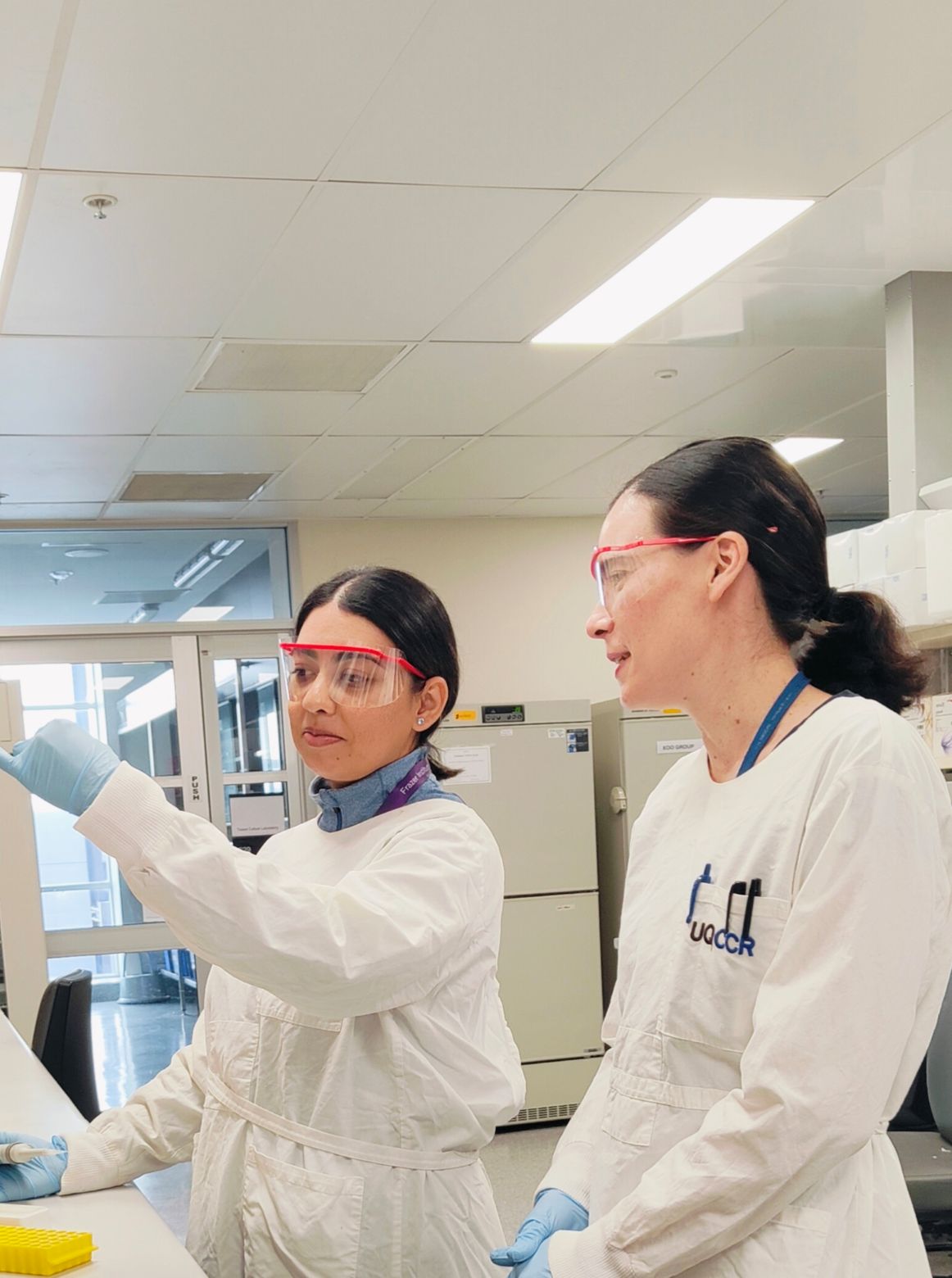
Zaina Jugon & Dr Eva Baxter